

The EU-ETS Observatory confirms the risk of loss of connectivity in container traffic at European ports compared to those located in neighbouring countries
• The report, presented by Puertos del Estado in Brussels, reveals an 11-point decline in the market share of the main European ports in the long-distance container segment, measured in TEU-miles, between 2023 and 2025.
• The data corroborate the growing weight of UK and Eastern Mediterranean ports in shipping lines’ route planning, accompanied by increased investment in these countries to enhance their capacities.
20-02-2026 (Organismo Público Puertos del Estado). The first results of the Observatory launched by Puertos del Estado to measure the impact of the EU-ETS (European Union Emissions Trading System) confirm a reduction in connectivity in long-distance container services calling at EU ports compared to neighbouring countries not subject to European environmental regulations, measured in terms of the TEU-mile parameter. This loss of market share increases the risk of a gradual erosion of connectivity at European ports in favour of those located in neighbouring countries.
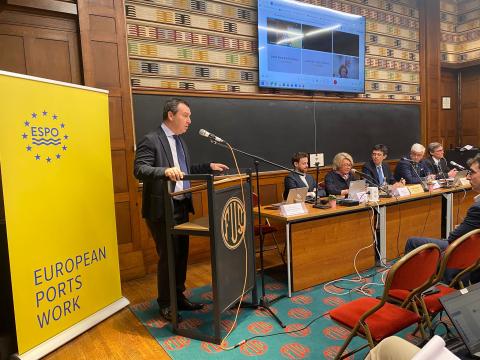
The President of Puertos del Estado, Gustavo Santana, highlighted during the presentation of these results to the European Sea Ports Organisation (ESPO) in Brussels that “Puertos del Estado’s support for the decarbonisation process is fully firm. However, we believe that certain aspects related to the application of the ETS to the maritime sector should be monitored and, where appropriate, reviewed in order to improve the system and contribute to the ultimate objective of reducing greenhouse gas emissions, while preserving competitiveness and control over our supply chain at all times.”
For her part, Polona Gregorin, Head of the Mobility Unit at DG CLIMA of the European Commission, thanked the Observatory for its work and noted that: “The Commission will continue to monitor the situation, while bearing in mind that decarbonisation is key to the competitiveness of the maritime sector.”
The detailed data show a decline in the market share of the main European ports (measured in TEU-miles — the vessel capacity in TEUs multiplied by the distance travelled) from 67% in 2023 to 56% in 2025, with the main decreases recorded in Northern Europe and the Eastern Mediterranean.
At the end of last year, the first results of the Observatory had already indicated an increase in activity at non-EU but geographically close ports, such as those in the United Kingdom — in Northern Europe — and in Egypt and Turkey — in the Mediterranean. The data show that in 2023, UK ports accounted for 17.5% of the total TEU-miles among the United Kingdom, Germany, France, Belgium and the Netherlands combined. By July 2025, this percentage had almost doubled to 32.1%. That 15-point difference over two years corresponds almost exactly to the losses recorded by the Netherlands and Germany combined.
In the Eastern Mediterranean, Egyptian ports recorded the strongest growth in TEU-mile share, rising from 35% in 2022 to 52% in 2025, while Greece experienced a sharp decline from 45% to 12% over the same period.
Regarding maritime routes, the Observatory has detected a significant increase in the relative weight of UK and Eastern Mediterranean ports in long-distance services. The situation in the Suez Canal, together with the reorganisation of shipping alliances, led to a general reshaping of routes, coinciding almost simultaneously with the entry into force of the maritime ETS, thereby generating a profound alteration of the market. However, while the canal closure has been highly relevant, this factor alone does not explain the growth in transoceanic connectivity currently observed in countries such as the United Kingdom or Egypt. Nor can it be attributed to usual factors such as a significant increase in economic activity, reduced operating costs, or congestion issues at neighbouring European ports.
This increase in traffic — again measured in TEU-miles — is accompanied by planned investments expected to increase port capacity at UK ports by 21%. In the Eastern Mediterranean, particularly in Israel, Turkey and Egypt, planned investments will allow capacity to increase by 43%, measured in millions of TEUs handled per year. Given that port expansions must be based on long-term projections, these investments suggest structural changes in maritime traffic flows rather than temporary factors.
As next steps, in addition to continuing to monitor the container segment, the Observatory will also track ro-ro traffic. In this sector, some data point to a possible return of trucks to road transport that had previously been shifted to maritime services, which, if confirmed, would lead to increased transport-related emissions and higher levels of traffic and congestion on European roads.
The Observatory, promoted by Puertos del Estado and developed by a consortium formed by Shipping Business Consultant (SBC), the Transport Innovation Centre (CENIT) and Nextport, aims to detect potential carbon leakage and traffic shifts in ports subject to the EU-ETS, which requires shipping lines calling at European ports to pay for their greenhouse gas emissions based on vessel capacity and route travelled.
The purpose of the Observatory is to alert authorities to evasive practices that may have occurred or could occur, enabling anticipation and response, while also supporting decision-making ahead of the review of the EU-ETS Directive scheduled for this year, including the definition of preventive or corrective measures.
European Union Emission Trade System
In the context of the fight against climate change, it was agreed in December 2022 to extend the European Union Emissions Trading System (EU ETS) to maritime transport. As a result, shipping companies must acquire allowances covering reported greenhouse gas emissions in accordance with the protocol defined by EU Regulation 2015/757.
Throughout the legislative process and since its entry into force on 1 January 2024, Spain — through the Ministry of Transport and Sustainable Mobility, to which Puertos del Estado reports — has led within the EU the analysis and warnings regarding the potential negative effects of this regulation, particularly in relation to route diversion and the relocation of maritime traffic hubs to ports in third countries where this environmental regulation does not apply. Risks to port competitiveness include the loss of strategic traffic for Europe, logistics relocation, reduced maritime connectivity — and consequently reduced logistics sovereignty — and increased operating costs, while bearing in mind that the intended objective of reducing carbon emissions will not be achieved if shipping lines choose to operate in neighbouring non-EU ports.