

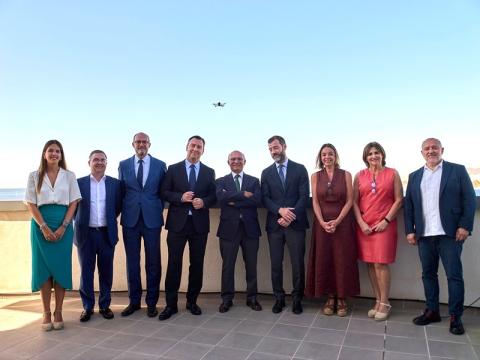
Puertos del Estado launches a Guide to support the safe integration of drones into ports
• Benito Núñez, Secretary General for Air and Maritime Transport, highlighted the importance of cooperation between public administrations, organisations and the private sector to promote the safe and coordinated deployment of Unmanned Aircraft Systems (UAS).
• Puertos del Estado president, Gustavo Santana, stressed that this initiative "demonstrates our commitment to innovation and the continuous improvement of the Spanish State-owned Port System."
09-07-2026 (Puertos del Estado). Puertos del Estado, together with the Port Authority of Málaga, presented today the Guide for the Use and Application of Unmanned Aircraft Systems (UAS) in the Port Environment, a project developed in collaboration with the Spanish Port Authorities, with the support of INECO and ENAIRE, and technical contributions and comments from SENASA, ITG and ITE. The Guide provides a common framework to support the progressive, safe and coordinated integration of UAS across the Spanish State-owned Port System.
Opening the event, Secretary General for Air and Maritime Transport Benito Núñez highlighted that "drones are no longer an experimental technology; they are now part of our productive fabric, with applications in areas such as logistics, infrastructure inspection, agriculture, emergency response and public services."
Núñez noted that UAS provide new operational solutions by enabling access to locations and the performance of tasks that were previously more difficult or hazardous, reducing risks and costs while improving resource availability. He also stressed that their deployment must continue to be based on safety, efficient airspace management and coexistence with other aeronautical and non-aeronautical activities.
The Secretary General also underlined Spain's coordinated efforts to promote UAS deployment and pointed to the National Action Plan for U-space Deployment and its updated version, PANDU+, as a clear and structured roadmap for advancing drone integration in Spain over the coming years. ENAIRE, Spain's national air navigation service provider, is playing a key role in European U-space projects such as UELCOME, SPATIO and ENSURE, aimed at enabling the safe integration of drones into complex environments through advanced digital air traffic management services.
For his part, Puertos del Estado President, Gustavo Santana, stated that this initiative "demonstrates our commitment to innovation and the continuous improvement of the Spanish State-owned Port System." He also emphasised that the Guide is the result of close collaboration between the Port Authorities, public bodies and organisations involved in the aviation and regulatory sectors, which "has made it possible to produce a practical and rigorous guide tailored to the real needs of Spanish ports and the current regulatory framework." He added that "this Guide represents a starting point for continuing to advance, in a coordinated manner, the integration of UAS into the port system."
Carlos Rubio, President of the Port Authority of Málaga, also stressed the importance of the initiative, noting that "the publication of this Guide comes at a critical time and addresses the need to standardise procedures, as demand for drone operations is growing significantly, both from Port Authorities for public domain monitoring and from private operators for a wide range of commercial purposes."
Also attended by representatives from the Directorate General for Civil Aviation and EMSA, today's presentation showcased a Guide that provides a comprehensive overview of UAS operations in the port environment. It covers governance, the regulatory framework, Port Authority operations, the management of third-party operations, protection against non-cooperative UAS, the main operational applications and the future evolution of this technology.
The use of drones is already a reality in many Spanish ports, where they are employed for perimeter surveillance and security, infrastructure inspection, topographic surveying, emergency management and water surface monitoring. These applications have proven their value by improving infrastructure monitoring, operational information gathering, environmental management, safety and emergency response.
Through this Guide, Puertos del Estado aims to facilitate the integration of UAS into the port environment by providing a common reference framework to address the regulatory, operational and organisational challenges associated with these technologies. The document has been conceived as a living reference that will support the ongoing evolution of the port system in a rapidly changing technological environment and serve as the basis for future innovation and digitalisation initiatives.
You can access the Guide here: https://www.puertos.es/system/files/2026-07/Guia_drones.pdf