
Border Facilities for passengers
Important
• If you want to know whether your entry is allowed (‘OK’ or ‘not OK’), as well as information about the number of days that you are still allowed to stay on the territory of the European countries using the EES, visit this page and fill in 6 requested information fields
• You can also ask the passport control officers at external borders about the number of days that you are still allowed to stay on the territory of the European countries using the EES.
In ports of general interest, in addition to the border established for goods, a border is also established for passengers embarking or disembarking; this border is a single one for the so-called Schengen Area. Therefore, when a non-EU citizen enters or leaves the Schengen Area, a border control is carried out.
The single border of the Schengen Area has been designed to be fully electronic, so that in the near future passports will no longer be stamped manually; instead, the Entry/Exit System (EES) will electronically register passports and capture facial images and fingerprints; entry will then be authorized or denied accordingly.
Port Authorities have contributed to this project of the National Police and the European Union by providing equipment that allows travellers to self-register and cross the border in an automated manner. These devices consist mainly of self-registration kiosks and automatic gates known as eGates.
You may consult the EU website and the National Police website for further information.
You can watch this video in ES-EN (arrivals/departures) or this video in ES-FR (arrivals/departures) to learn how this self-registration process is carried out at the kiosks installed in ports. These kiosks are installed:
in maritime terminal or cruise terminal buildings; and
on the quays, inside booths or containers specially designed for controlling travelers traveling with their vehicles.
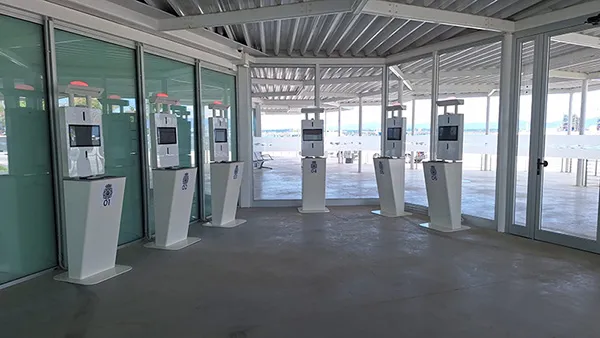
Kiosks for self-registry at passenger terminal
(Source: Tarragona Port Authority)
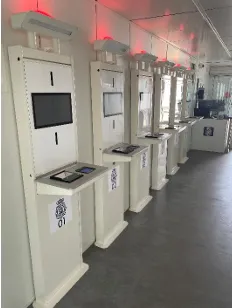
Kiosks for self-registry at mobile border control office (container)
(Source: Valencia Port Authority)
This project has been co-financed by the European Union.