

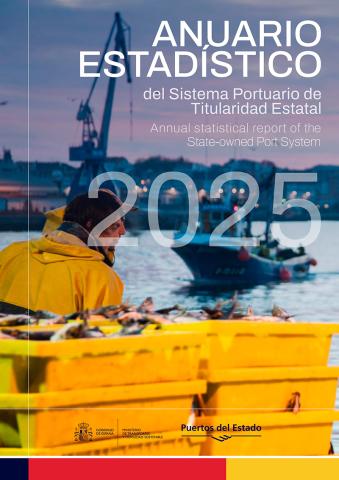
Puertos del Estado publishes the 2025 Statistical Yearbook, featuring comprehensive data on Spain’s state-owned port system
- Spanish ports handled 556.2 million tonnes of cargo in 2025, representing a 0.3% decrease compared to 2024.
- The publication also includes the technical characteristics of ports, providing a detailed overview of the national port infrastructure and capacity.
1 October 2026 (Puertos del Estado). Puertos del Estado has published the 2025 Statistical Yearbook of the State-Owned Port System, providing comprehensive information on Spain’s ports. The Annual Data Dashboard for 1962–2025 has also been updated, allowing users to access port traffic data interactively and make comparisons across different years.
The 2025 Statistical Yearbook compiles recorded data on cargo traffic, container traffic, vessel movements and passenger traffic across the 28 Port Authorities that make up Spain’s general-interest port system. It also includes the technical characteristics of the ports.
The final figures for 2025 published in the Yearbook confirm that a total of 556.2 million tonnes of cargo were handled during the year, representing a slight decrease of 0.3% compared to 2024, against a backdrop of global geopolitical and economic instability.
Total passenger numbers reached a new record. In 2025, passenger traffic through Spanish ports increased by 4% compared to 2024, reaching a total of 42.49 million passengers. This once again highlights the importance of the state-owned port system in ensuring connectivity and territorial cohesion.
Regarding Spain’s national port infrastructure, its 46 general-interest ports offer nearly 395,000 linear metres of quays, almost 100 million square metres of land and storage areas, and 2,145 navigational aids managed by the Port Authorities, including 204 lighthouses and major lights, among other facilities.
The figures presented in this publication confirm that maritime freight transport remains essential to Spain’s trade. Its advantages over other modes of transport include lower unit costs over long distances, the ability to handle large volumes of cargo, and its status as one of the safest and least polluting transport modes. According to data from the Spanish Tax Agency (AEAT), approximately 71% of Spain’s imports and 52% of its exports are transported by sea.
The full report is available at the following link: