

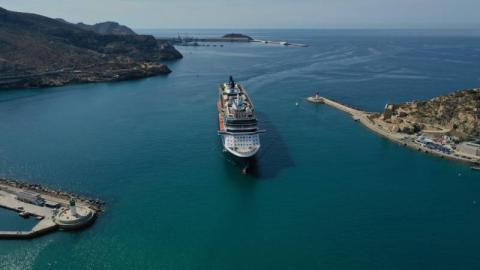
Spanish ports present their greener and more sustainable cruise tourism offering at Seatrade Cruise Med
- The trade fair, held in Las Palmas on 16 and 17 September, is the largest European event in the cruise sector
- The stand led by Puertos del Estado will feature 26 Port Authorities
16-09-2026 (Organismo Público Puertos del Estado). Puertos del Estado and the ports of general interest will participate on 16 and 17 September in Seatrade Cruise Med, which is celebrating its 30th edition in Las Palmas de Gran Canaria. During these two days, Spanish ports will present their infrastructure and services offering for cruise tourism, with a firm commitment to the sustainable future of the sector.
The new cruise terminal at Muelle Santa Catalina will host more than 2,000 cruise professionals from 90 countries, 180 international exhibitors and more than 60 cruise lines.
Under the claim “Make your landing unforgettable”, 26 Port Authorities will participate in the Ports of Spain stand, showcasing the advantages of choosing Spanish ports as homeports and ports of call on cruise routes.
In addition to business meetings and working sessions, the event agenda includes various presentations. On the 16th, the official opening of the trade fair will take place, with an address by the president of Puertos del Estado, Gustavo Santanta, and the institutional welcome event at the Ports of Spain stand, at 13:00.
At 11:15, the stand will host a presentation by the Port Authority of Ferrol of the Ferrol Cruise Port cruise terminal, whose project envisages the construction of a terminal capable of accommodating large vessels, as well as a second mobile facility allowing several simultaneous calls to be handled.
Next, at 11:45, the Port of Almería will present its new services for cruise passengers and projects that are transforming the port to open it up to the city.
Finally, at 12:15, the Port Authority of A Coruña will present the Mega project (Mundo Estrella Galicia), a museum dedicated to the history of the company and the beer-making process.
On Thursday the 17th, Puertos del Estado has organised an exclusive working breakfast for the ports with the leading cruise lines.
At 10:15, the Port of Cádiz's OPS (Onshore Power Supply) service will also be presented at the stand, launched together with Endesa in March of this year, making it the first port in Spain to offer shore power connection to berthed cruise ships.
The Port Authority of Castellón, for its part, will promote its “The Five Senses” campaign, aimed at the boutique and luxury sector, at the Ports of Spain stand at 10:45.
At the MedCruise pavilion, at 15:00, Verónica Verdesoto, Head of the Commercial Services and Bunkering Department at Puertos del Estado, will participate in the sixth meeting of the Working Group on Economic Impact Assessments, dedicated to developing tools to analyse long-term value creation and the sustainability of cruise tourism, seeking to balance the benefits for the sector with the well-being of communities.
Sustained growth
In 2025, cruise passenger traffic through the ports of general interest exceeded 14 million movements, aboard 5,300 vessels, consolidating Spain's position as a leading destination at European level. In the first seven months of this year, this figure stands at 7.71 million, 1.7% more than in the same period of the previous year.
The cruise industry contributes directly, indirectly or through induced effects €6.4 billion to national output, around €3.2 billion to GDP and approximately 52,000 total jobs, according to the ‘Study on the economic impact of ports of general interest on the Spanish economy as a whole’, prepared by Puertos del Estado.
Puertos del Estado and the Spanish port system are working to ensure sustainable growth in cruise tourism, a strategic element for the Spanish economy.
The commitment to sustainability is reflected in concrete initiatives for environmental protection, territorial cohesion and the respectful integration of the activity into port cities; such as the implementation of shore power supply at quays, which allows cruise ships to connect to the electricity grid while berthed, switch off their auxiliary engines and thereby reduce pollutant emissions and noise during their stay.
At the same time, other energy-saving and pollutant-emission reduction measures are under way, such as the optimisation of digital operations, the use of low-carbon fuels or the use of renewable energy sources in port ecosystems.