
Spanish ports showcase their advantages as a logistics platform for fresh produce at Fruit Attraction
- State-owned ports handled almost 8 million tonnes of fruit and vegetables in the first eight months of the year.
- The stand led by Puertos del Estado brings together 15 Port Authorities, with an extensive programme of meetings and presentations.
5 October 2026 (Puertos del Estado). Puertos del Estado and 15 Port Authorities will take part from tomorrow through 8 October in the world’s leading trade fair for the fruit and vegetable sector, with the aim of opening up new markets and consolidating Spanish ports as a major logistics platform for the international trade of fresh produce.
“Spain is a global agri-food powerhouse and one of the EU’s leading food exporters. Taking part in Fruit Attraction gives our country the opportunity to showcase the strength of the Spanish port system as a major logistics platform for global fresh produce trade. Spanish ports ensure safe storage conditions, traceability and compliance with the demanding timeframes that are essential to the sector,” said Gustavo Santana, President of Puertos del Estado.
In 2025, ports of general interest handled 10.26 million tonnes of fruit and vegetables. In the first eight months of this year, the figure has reached 7.98 million tonnes.
With more than 2,500 exhibitors and more than 121,000 professionals from 150 countries expected to attend, Fruit Attraction is gaining further prominence as the leading international trade fair for the fruit and vegetable sector. The event provides an opportunity to share the latest technological developments and drive commercial activity.
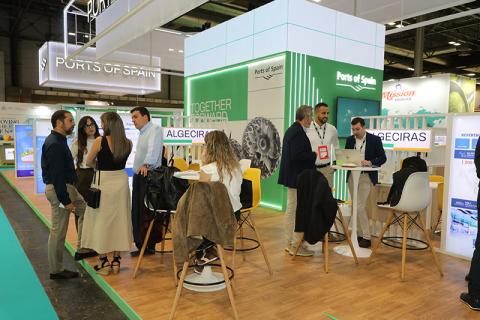
Under the claim “Moving the best of nature”, the Ports of Spain stand, led by Puertos del Estado, covers 215 m². The 15 participating ports — Alicante, Algeciras Bay, Cádiz Bay, Barcelona, Bilbao, Cartagena, Castellón, Huelva, Las Palmas, Málaga, Motril, Seville, Tarragona, Valencia and Vigo — will hold an extensive programme of business meetings and showcase the competitive advantages of choosing their cold-chain facilities and international connectivity for the transport of fruit and vegetables.
On Tuesday, Puertos del Estado President Gustavo Santana will welcome visitors at the Ports of Spain stand at 1:00 p.m. On Wednesday, at 11:00 a.m. at the same location, the Port of Valencia will give a presentation entitled “Valenciaport: Where Fresh Produce Connects”, delivered by Mar Chao, President of the Port Authority of Valencia.
Round table
Immediately afterwards, at 12:30 noon, the Fruit Next 4 area in Hall 4 will host the round table organised by Puertos del Estado, “Innovation in the Cold Chain: The Strategic Role of Ports”. The session will be moderated by Pedro García Navarro, Director of Operations at Puertos del Estado, and will feature Andima Ormaetxe, Director of Operations at the Port Authority of Bilbao; Jaime Manuel Beltrán, Head of Business Development and Commercial Affairs at the Port Authority of Huelva; and Ignasi Sayol, CEO of Inprous. The speakers will discuss the latest innovations in infrastructure and sustainable solutions for global trade.
Spain is the leading country in Europe in terms of maritime connectivity, with more than 200 connections to ports around the world. Spanish ports also offer highly specialised facilities and infrastructure incorporating the latest technological advances, including almost 100 million m² of land and storage areas, more than 2 million m³ of refrigerated storage capacity, reefer connections, advanced temperature-control technology and almost 395,000 linear metres of berthing facilities.
Among the digital solutions promoted by Puertos del Estado, DUEPORT stands out as the port single window that centralises and facilitates the exchange of information and the management of procedures associated with vessel calls, as well as its adaptation to the European Maritime Single Window Environment (EMSWe). INTEGRA2 enables improved internal process management across the different port systems and stakeholders, while SIMPLE is a logistics information-sharing platform that facilitates interoperability, traceability and coordination among the various actors in the transport chain. Special mention should also be made of VUAPORT, an application for managing the positioning and inspections carried out at Border Control Posts, designed to streamline and optimise inspection processes and the coordination of the various stakeholders involved in border controls.
In the field of fuels, state-owned ports are currently deploying OPS (Onshore Power Supply) systems, which allow berthed vessels to connect to the onshore electricity grid and switch off their auxiliary engines, thereby reducing noise and pollutant emissions. Spain is also positioning itself as a leading European hub for the production and distribution of cleaner fuels, particularly in the supply of LNG to vessels.
Finally, Puertos del Estado is promoting maritime-rail intermodality, enabling Spain to improve its global competitiveness through shorter waiting times and faster transport between ports and the final destination of goods. This helps ensure that perishable refrigerated food reaches its destination in optimal condition.